
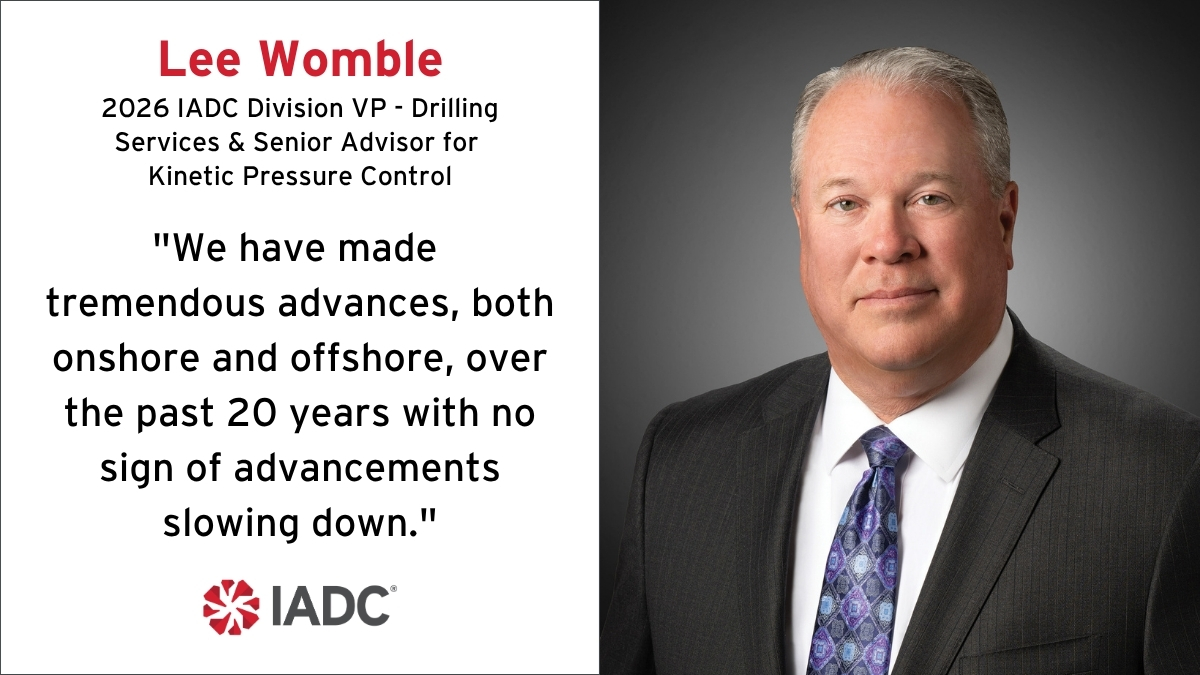
In his editorial in the Mar/Apr issue of Drilling Contractor, IADC Division VP – Drilling Services Lee Womble highlights the ongoing work of IADC’s Drilling Services division and how it continues to champion technological advancement, even amid today’s capital-constrained environment.
Lee begins by outlining the breadth of IADC Drilling Services, which encompasses the Advanced Rig Technology (ART), Technical Publications, Drilling Engineers, Underbalanced Operations and Managed Pressure Drilling, and Cybersecurity committees. He then focuses on the ART Committee as an example of how IADC supports innovation in practice—from its annual Advanced Rig Technology Conference to its Spark Tank events for startups and individuals, to ongoing work publishing papers and guidelines on AI, bit dull grading, and additions to the IADC Lexicon.
Lee acknowledges the commercial reality facing the industry, noting that outside of a build cycle, Members need a clear justification for technology investment. He emphasizes that implementing new rig technology requires a genuine partnership between drillers and operators, including considerations like performance bonuses or dedicated rig time for commissioning. As Steve Angstmann, CEO and Co-Founder of Kinetic Pressure Control, puts it,
“The only thing more important for an innovation project to succeed than a good idea is a good partner.”
Lee also stresses that in today’s environment, any new rig technology must be retrofittable to existing rigs rather than requiring newbuilds. A quote from Gene Stahl of Precision Drilling reinforces this point, emphasizing that advances need to roll out across multiple rigs rather than remain one-off experiments.
On safety, Lee notes that rig floor personnel are, in effect, working inside a machine—making it essential that new technology is designed to fail safely and that crews are properly trained. He also points out that as more scopes like MPD, fluids management, and cementing shift from operators to drillers, the associated capital and risk burdens on drilling contractors are growing.
Finally, Lee highlights the underutilized value of data the industry has already collected, noting that cleaner, better-used operational data represents a significant area for growth—even before diving into AI.
Lee closes by reflecting on two decades of meaningful progress and encouraging all Member companies to engage with the ART Committee and help carry these advances forward across the industry.