

Meeting & Venue Details
All times listed are central.
The event will be in-person only. Please register early to ensure your seat as space is limited.
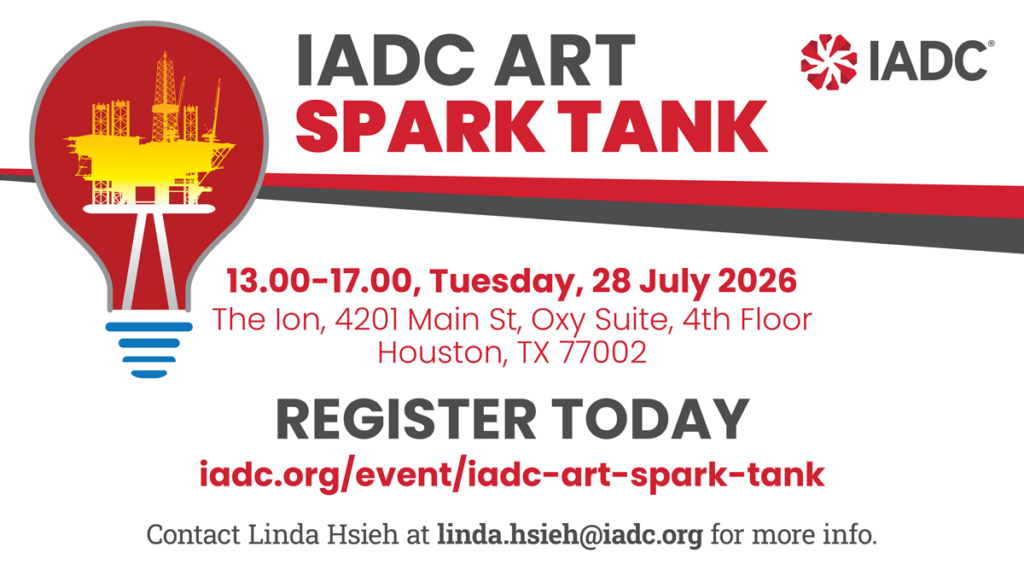
The Ion, 4201 Main St, Houston, TX 77002 (click here for directions and parking instructions)
Oxy Suite, 4th Floor
Supported by Oxy, Patterson-UTI and Transocean

IADC ART Spark Tank
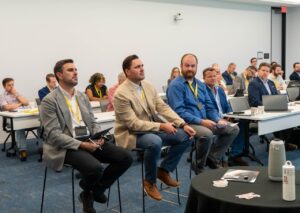
To encourage innovation in the drilling industry, IADC ART will hold another edition of its Spark Tank series on the afternoon of Tuesday, 28 July. Spark Tank is a forum to “spark” new thinking. It is an opportunity to provide active and aspiring technology entrepreneurs with a new opportunity to pitch their products and ideas to a panel of drilling contractors, operators and service companies (“sharks”).
The purpose is to provide insights (“sparks”) to technology developers into what matters to those they are innovating for. There is sometimes a vast disconnect between a good idea and a great product, and these events attempt to close that gap in a good-natured, productive manner. Spark Tank presentations will allow the Sharks to ask questions and provide technical and business feedback from the perspective of the product’s intended end user.
Thanks to our Drilling Sharks:
- Anil Godumagadda, Vice President, Digital Solutions, Patterson-UTI
- Chris Spears, Managing Director, Energy Innovation Capital
- Mitch Loyd, Head of Technology, Woodside Energy
- Robert Schapiro, Global Energy & Resources Partnerships Leader, Microsoft
Agenda
13.00 Coffee and Networking
13.30 Welcome, introductions and facility safety briefing – Trent Martin, Transocean, and Alex Groh, Patterson-UTI (IADC ART Committee Co-Chairs)
Speakers have 15 minutes, with 15 minutes allotted for Sharks’ Q&A
13.45 “AI Agent for Automating Bit Dull Grading”: Oxana Gubaidullina, Gain.Energy
Automated bit dull grading involves many nuances, and capturing the full range of variables while keeping the user experience simple has always been a challenge. Agentic systems address this by providing the flexibility to select the right tools for maximizing cutter coverage and grading quality. A bit‑dull‑grading agent elevates this process even further — delivering consistent, descriptive IADC codes with speed and repeatability.
One of its key strengths is availability across multiple platforms. Whether you are in the field preparing a rig report on a mobile phone, working from a personal laptop or finalizing documentation in the office, the bit‑dull‑grading agent remains accessible and reliable. The value grows significantly when this agent is integrated into broader digital workflows. Connected with other agents, it becomes a powerful component in automated analytical chains — generating ready‑to‑use end‑of‑well reports, supporting multi‑factor dysfunction investigations, and accelerating offset‑well reviews without manual effort. This shifts dull grading from a repetitive, isolated task into a scalable, insight‑driven capability that strengthens decision‑making across the entire well lifecycle.
By embedding this agent into daily operations, organizations can reduce operational costs, improve product development cycles, and accelerate innovation—transforming dull grading from a routine obligation into a strategic enabler of performance and efficiency.
14.15 “An Operating System for Wells, Starting with a Physics-AI Drilling Digital TWin”: Sai Rao, drillers.ai
The drilling industry loses roughly $16B per year from borehole related downtime and inefficient operations. The root cause is subsurface uncertainty. Meanwhile, well planning and execution run in silos, and the feedback loop between wells is manual, slow, and often never closes.
drillers.ai is building a physics-AI drilling digital twin: a transient wellbore simulator spanning the full hole-section sequence from integrity test interpretation, drilling to TD, circulation optimization, trip-out advisory, casing-run assessment, and cementing. Existing software addresses only fragments of this workflow. A state-of-the-art agentic AI backend architecture orchestrates between the physics engine and live sensor data to deliver human-in-the-loop physical AI: rig sensor data streams in, the model returns alerts and recommendations, and the driller acts to prevent problems before they occur. No product combines these capabilities in a single real-time engine spanning the full hole-section sequence.
The digital twin is the foundation of a larger vision: an operating system for wells with an AI-native well data model that learns from every foot drilled, just as Waymo learns from every mile driven. The platform is built to serve every energy well: oil & gas, geothermal, lithium brine, carbon storage, and geologic hydrogen by eliminating downtime in hydrocarbon wells while making the clean energy wells that underpin the energy transition cost-competitive from day one. The goal is a single platform: every well, every energy.
The presentation will include a demo of the product prototype. The team combines a Ph.D. in engineering, 10 years of drilling R&D and deepwater operations experience, a Stanford business degree and Stanford AI/ML engineering.
14.45 Networking Break
15.00 “Advanced Hydrogen Injection System: Superior Fuel Consumption Reduction and Emissions Performance”: Matt Eve, Sophia Oilfield Supply Services, and Carlos Benedito, ICBC
Drilling contractors worldwide face an urgent imperative: reduce operational costs (OPEX) and decarbonize operations without compromising performance or safety. Volatile fuel prices, rising carbon emissions and imminent environmental regulations (IMO 2030+) are reshaping the industry. These pressures demand practical, high-impact solutions that deliver measurable competitive advantages across both onshore and offshore operations.
While existing hydrogen injection technologies have shown modest fuel savings, Evo Hydrogen introduces a proprietary, next-generation resonant electrolysis platform engineered for superior performance and efficiency. This technology leverages advanced resonant oscillation principles, using resonant cylinders to amplify water molecule vibration through alternating electrical waves, enabling a more efficient hydrogen generation process.
The system allows direct hydrogen injection into existing engine intake systems without requiring equipment modifications, ensuring rapid deployment and minimal disruption. Fuel consumption reductions can reach up to twice those of conventional hydrogen injection solutions, while CO₂ emissions reductions can approach 80%, significantly improving environmental performance.
Designed for broad applicability, the technology integrates with major engine platforms such as Cummins and Caterpillar units used across drilling operations. Its modular architecture supports scalability and adaptability across multiple asset classes and operating environments worldwide.
For IADC stakeholders, the advantage is clear: lower fuel costs, stronger ESG positioning in tenders, preparedness for carbon pricing, and reduced environmental and operational risk. Evo Hydrogen enables contractors to turn regulatory pressure into sustainable competitive advantage.
15.30 “AI for Well Planning Optimization”: Viswanath Avasarala, DeepIQ
When planning a new well, a lot of administrative time is spent searching for documents and all other corporate knowledge relevant to the specific project.
Now, agentic AI can be employed to ingest a drilling organization’s historical data, from multiple sources, into a private data lake. This may be all available corporate drilling data, or as much as required for a specific project, including end-of-well reports, after-action reports, service company reports, lessons learned and standard operating procedures.
This can all be achieved within the cloud tenant of the operator organization, so no need for data extraction, analysis and delivery.
The data can be contextualized to form a knowledge graph in which every data point understands its relationship to every other data point. This also provides guard rails to enable strong hallucination mitigation.
A natural language interface facilitates interrogation of the knowledge graph, much as we do with publicly available large language models. This data accessibility and interrogation process achieves:
a. Considerable time saving during well planning with all appropriate drilling data available immediately. The data search and analysis process can take a few days rather than weeks.
b. Improved drilling performance with all successfully implemented optimization procedures available for analysis. These could be using specific downhole tools with a specific drilling fluid, though a specific lithology at a specific trajectory.
c. Reduced nonproductive time as all historical risks can be identified and successful mitigation procedures recorded.
16.00 Networking Happy Hour: Second Draught located inside The Ion
For more information, contact Linda Hsieh, linda.hsieh@iadc.org, +1-713-292-1945, ext 219.
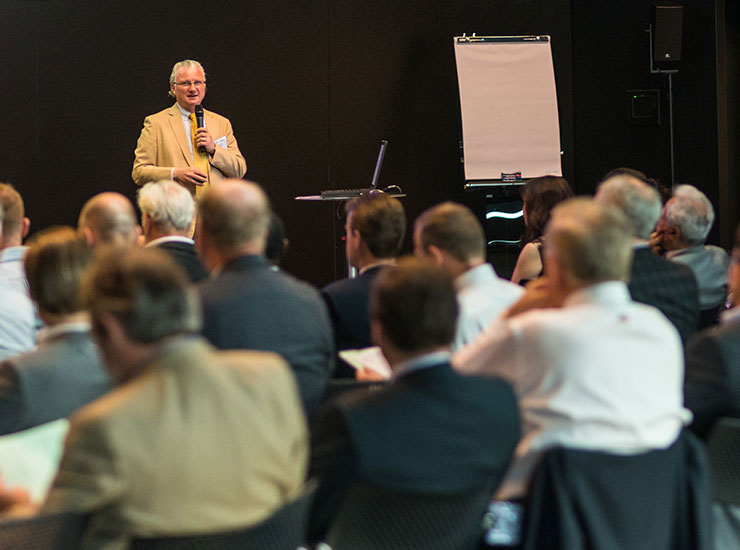
IADC ART Committee Mission
To improve safety and efficiency through sound operating procedures, design of automated systems and standardizing automation.
